
_Jamie_McDermaid_(1).jpg)
Counting Puffin Burrows
Summer 2026
Counting seabirds is a bit like counting leaves on a tree – timing is critical. Count too early and some haven’t yet appeared; too late and others have already gone.
We usually count seabirds in late May and early June, when they are settled on nests or eggs, making them easier to survey. Identifying thousands of nests or breeding sites on cliffs and islands is still a challenge, but counting Atlantic puffins is even trickier as their nests are hidden away in underground in burrows.
_Jamie_McDermaid.jpg "A puffin burrow in a grassy/muddy slope, vegetation well-trodden at the entrance, the edges smooth and rounded by use, the entrance low and wide")
From a distance, you can’t always spot the entrances of puffin burrows amongst rocks and vegetation, even with a good pair of binoculars. If you do identify a burrow entrance, determining if it is being actively used by a puffin (compared with an old burrow or a rabbit burrow), is not always possible without careful inspection. Therefore, counting puffins on small islands like Craigleith and Fidra (RSPB reserves) or the Lamb (privately owned) requires walking across the whole island and can take most of a day. Because of these challenges, and to minimise disturbance for breeding seabirds, puffin burrows are counted every 2 years as opposed to annually as most other species are.
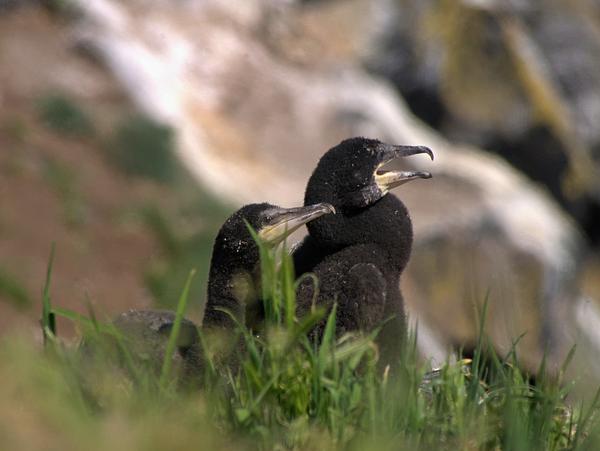
Most puffin surveys take place in May, including surveys covering Craigleith island and the majority of Fidra island. However, some areas on our local islands are occupied by breeding cormorants - a species which is easily disturbed and will abandon their nests for long periods if scared away. Therefore, the remaining surveys in these sensitive areas are completed in August, when most seabird chicks have left the islands.
The challenge of organising and delivering the puffin burrow counts is shared between the Scottish Seabird Centre and the fantastic volunteers of the Forth Seabird Group (FSG). The FSG has been counting seabirds in the Firth of Forth since 1959, and without their incredible dedication we wouldn’t know as much as we do about the important seabird populations breeding on our local islands. These counts have much to tell us about how seabirds are faring year on year, but also open our eyes to the health of the wider marine environment and ecosystem.
This year’s counts revealed that, compared to 2024, Craigleith’s puffin population has dropped from just over 5,100 apparently occupied burrows (AOBs i.e. burrows we think puffins used for nesting in this year) to around 4,100. The puffin population on the Lamb also decreased, by about 15%. It's important to note that puffin populations on Craigleith do have a habit of fluctuating between counts, and that puffin numbers are still within the typical range for the Lamb since regular counts began for this island in recent years. However, it will be key to keep a close eye on these colonies over the coming years.
_Emma_Marriott.jpg "Four people crawl on their hands and knees over a grassy slope pockmarked with puffin burrows. Some have their arms halfway down the tunnels as they search for evidence of use by puffins for breeding earlier that summer.")
On the Isle of May, where the counts are led by NatureScot and the UK Centre for Ecology & Hydrology, an even steeper population decline was noted this year, from 52,000 to an estimated 36,500 AOBs in 2024 and 2026 respectively. It’s worrying news from a critically important site for breeding puffins, and a stark reminder of how vulnerable our seabirds are to the impacts of climate change.
Puffins are especially vulnerable to these impacts, which can include more regular storms and reduced food availability as sea temperatures rise. Only last winter, there were reports of thousands of dead puffins washing up on beaches around the UK and Europe, which has been linked to the string of severe storms they experienced out at sea where they live over winter. Puffins are adapted to withstand tough conditions out on the open water, but as these storm events become more frequent and extreme, even the most resilient seabirds cannot escape the impacts.
_Nicol_Nicolson,_Scottish_Seabird_Centre.jpeg "Dozens of puffins gather on an outcrop of rock splashed with white guano and yellow and green lichens. North Berwick law is visible in the distance.")
Tackling climate change must be central to protecting this icon of the seas for the future. Better management of our seas is also urgently needed to reduce other pressures and give puffins – and all seabirds – the best chance of recovery.
It isn’t all bad news. We saw an increase in the puffin population on Fidra by over 100 AOBs since the previous count. We should also remember that seabird populations naturally fluctuate. If we allow them time and tackle the pressures they’re facing, we can promote their population recovery.
For now, the nests and burrows are empty and the islands’ seabirds have departed. The leaves on the trees will soon follow, but we will leave the leaf-counting to someone with more patience.
We are hugely grateful to everyone involved in the counts, particularly the FSG who have been leading seabird counts across most of the Firth of Forth’s islands since the late 1950’s, and we look forward to continuing to collaborate over the coming years to monitor seabirds and support their local recovery.
Acknowledgements
Craigleith and Fidra are both under RSPB Scotland ownership and the Lamb is owned by Uri Geller. In June, RSPB Scotland and the Scottish Seabird Centre launched an ambitious new partnership project ‘Safeguarding Forth Seabird Islands’ . This project is made possible with The National Lottery Heritage Fund. Thanks to National Lottery players, we will be able to work more closely in partnership to protect vulnerable seabirds and inspire more people to love and protect them.