_Jasper_Rea.jpg)
Installing Our New 360 Camera Network
Bass Rock is one of nature’s most dramatic stages—a jagged island rising from the North Sea, crowned by a lighthouse and teeming with life. For decades, it has been a sanctuary for Northern gannets, the UK’s largest seabird, whose white wings and golden heads make them a breathtaking sight. The Scottish Seabird Centre has operated a range of traditional live cameras on the island for many years, but they provide only a narrow glimpse of the life on the island and the hostile conditions and dependency on moving components have created technical challenges.
_Jamie_McDermaid.jpg)
That’s why we set out on an ambitious mission: to install two 360-degree cameras on Bass Rock, bringing its wild beauty—and the stories of its gannets—directly to our visitor centre and to the public, and to create a new tool to help us study this internationally important seabird colony and its recovery from avian flu.
The project was made possible thanks to support from the Scottish Marine Environmental Fund, as well as the hard work and assistance of our delivery partners Audio Light Systems.
From idea to reality
Turning this vision into a reality wasn’t easy. Bass Rock is remote, exposed to the elements, and home to sensitive wildlife—so our technology had to be tough, reliable, and unobtrusive.
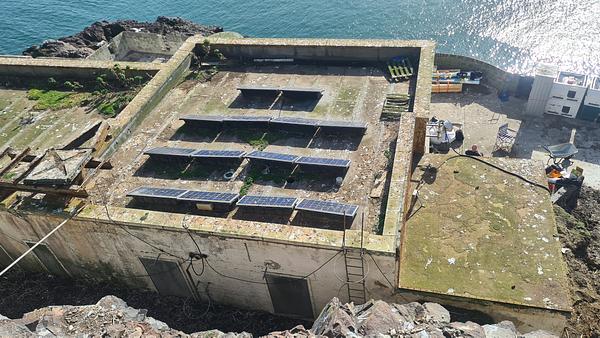
We chose 360-degree cameras with no moving parts, as experience taught us that mechanical systems often fail in harsh coastal conditions. Powering them required a robust solar and battery setup, and transmitting the footage meant finding a stable data connection. Our first plan for 5G connectivity hit a snag, so we switched to a point-to-point link to ensure reliability.
After a competitive tender process, we partnered with Audio Light Systems, whose expertise and value for money made them the perfect fit. With the equipment ready, the next challenge was getting it all to the island.
_Jasper_Rea.jpg)
The installation
March 2026 was a whirlwind. First we had to get a lot of heavy equipment over to the Bass; a task made possible thanks to support from the Northern Lighthouse Board (NLB). The Bass is home to an exceptionally beautiful lighthouse that is looked after by the NLB, and this winter past they were carrying out some maintenance to the buildings. By good fortune that meant they had a helicopter lifting equipment off the Bass and the NLB were kind enough to deliver our materials for us. Items were assembled and packed at Auldhame Farm and lifted from there, over two miles of sea, to the rock.
The install itself couldn’t take place until we could access the island. We usually use our RIB to access the Bass but it was delayed in coming back from its wintering grounds (!), but Seafari, our boat partners, successfully devised a way to land with the Sula, a larger boat that had never landed on Bass Rock before. The works were carried out by the Audio Light Systems (ALS) team and myself, with our Bass Rock guide Maggie Sheddon, providing invaluable guidance.
_Jamie_McDermaid-3.jpg)
As usual, the weather had other plans. Stormy seas and high winds forced delays, but by the end of March, the cameras were in place and a new point-to-point connection between our Centre in North Berwick and the Bass had been installed, and following some technical wizardry by ALS, the live feeds finally came online at the end of April.
More than a pretty picture
This project is about opening a window into a world most of us never get to see. Here’s how we’re using the cameras to make a difference:
For conservation - Researchers will be able to use the footage to monitor the gannet population and and study their behaviour. The insights we gain will help us protect them better. We also plan to test new ways for volunteers to get involved through citizen science. Stay tuned for news on this!
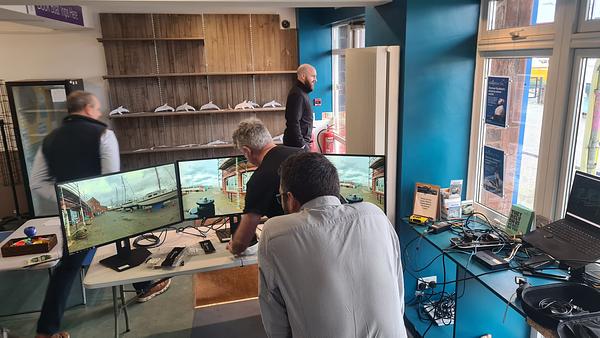
For you - Whether you’re at home or visiting the Scottish Seabird Centre, you can now experience Bass Rock like never before. Low-resolution live feeds are available on YouTube, while high-definition panoramas are on display at the Centre, in our Discovery Experience.
_Jamie_McDermaid_Scottish_Seabird_Centre.jpg)
What’s Next?
This is just the beginning. Over the coming months, we’ll be fine-tuning the system, and exploring new ways to use the cameras. We’re also hoping to upgrade the solar power system for 2027, so the cameras can keep running smoothly throughout the year, and we plan to unveil new plans to allow visitors to experience the feeds in our Centre very soon!
A big thank you
None of this would have been possible without the support of SMEEF. Their funding has allowed us to push the boundaries of wildlife monitoring and bring Bass Rock’s story to life in a way that’s never been done before. ALS have also gone above and beyond to deliver this challenging and unusual project, for which we are deeply grateful. Our thanks also to the Northern Lighthouse Board and Auldhame Farm for their invaluable assistance.
This project is supported by the Scottish Marine Environmental Enhancement Fund (SMEEF) using funds made available by the Scottish Government's Nature Restoration Fund.