
_Jamie_McDermaid.jpg)
Conservation Round-Up 2025
The Conservation Team reflect on 2025's achievements at the Scottish Seabird Centre and look forward to the coming year.
The new year ushers fresh ideas, hopes and opportunities. It’s a time to look forward and consider what we want for the future, but also to look back at what we’ve already achieved to appreciate how far we’ve come.
2025 has been a busy yet exciting year for the Scottish Seabird Centre. Coorie doon and join us as we reflect on the Conservation Team’s highlights and what we’re looking forward to in 2026…
SOS Puffin
The SOS Puffin project is about to enter its 19th year. Before 2007, when the project began, tree mallow covered over 80% of Craigleith island and had spread to the Lamb and Fidra, where it grew in dense ‘forests’ up to 3 metres tall and smothered puffin nesting areas.
Thanks to over 1400 volunteers, tree mallow is on the retreat, yet it will continue to regenerate each year until the seeds in the soil are no longer viable. This could take a very long time, especially if existing plants are allowed to grow, flower and produce more seeds. For this reason, the project will still be needed for a long time yet to continue to ensure local puffin populations have a place to stay.
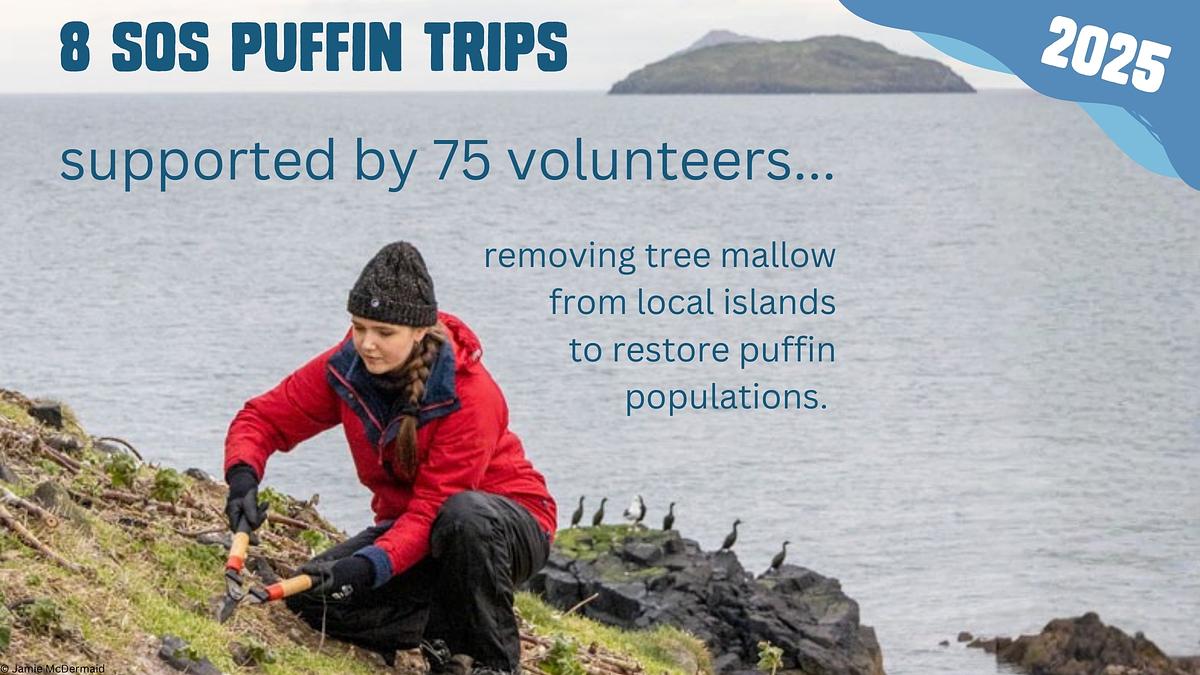
Craigleith now supports over 5000 pairs of puffins, up from what was thought to be less than a thousand pairs before the project began. The next puffin burrow count is planned in partnership with the Forth Seabird Group for 2026, so keep an eye out for how we get on later next year!
To all of you who contributed, including our wonderful volunteers, Lothian Sea Kayak Club and our project partners at RSPB Scotland, thank you for your dedication.
Seabirds
Each year, we have the pleasure of helping the brilliant Forth Seabird Group conduct seabird population counts on the varied islands of the Firth of Forth. These counts offer insight into how each species is faring locally from year to year and feed into larger, national datasets. We were relieved to see that the populations of most of the species counted remained stable compared to 2024, though many are still down on their five-year average and show how important it is to look at the bigger, long-term picture.
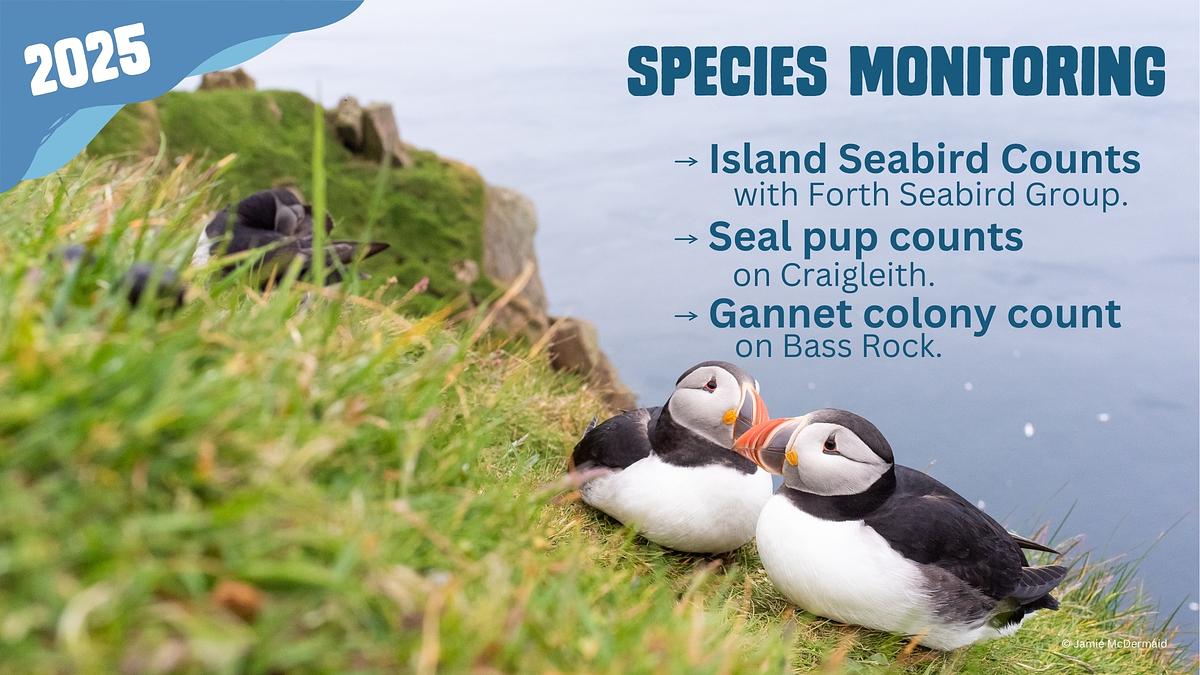
Since 2023, we have conducted an annual colony count of the Bass Rock gannetry using imagery from a state-of-the-art drone in partnership with The University of Edinburgh’s School of Geosciences, the UK Centre for Ecology & Hydrology, and Edinburgh Napier University. The 2023 and 2024 counts showed that the Northern gannet population on Bass Rock has declined steeply since the last seabird census in 2014, evidencing the high mortalities seen during the 2022 outbreak of Avian Flu and confirming that it will take many years to fully recover. It remains to be seen what the 2025 counts will show. The detailed images are currently being analysed by project partners, and the results will be released in early 2026.
These counts look at ‘apparently occupied sites’, but not all sites (i.e. nests) will produce a chick each year. To understand what the population counts can tell us in more detail, we have also been monitoring ‘productivity’ on the Rock. This involves selecting ‘plots’ around the colony and following the individual sites within each plot to track what percentage of the population successfully raised a chick to fledging this year. Stay tuned in 2026 for the results!
Policy & Campaigns
This year, we've plunged into the world of policy and campaigning. Seabirds are facing mounting threats and, whilst small scale conservation projects do make a difference, we need a national and international collaborative approach to safeguard these precious species for the future. Whether it's supporting campaigns with our environmental partners or leading e-actions, we're striving to ensure seabirds (and you at home!) are given a voice and the respect and recognition they deserve.
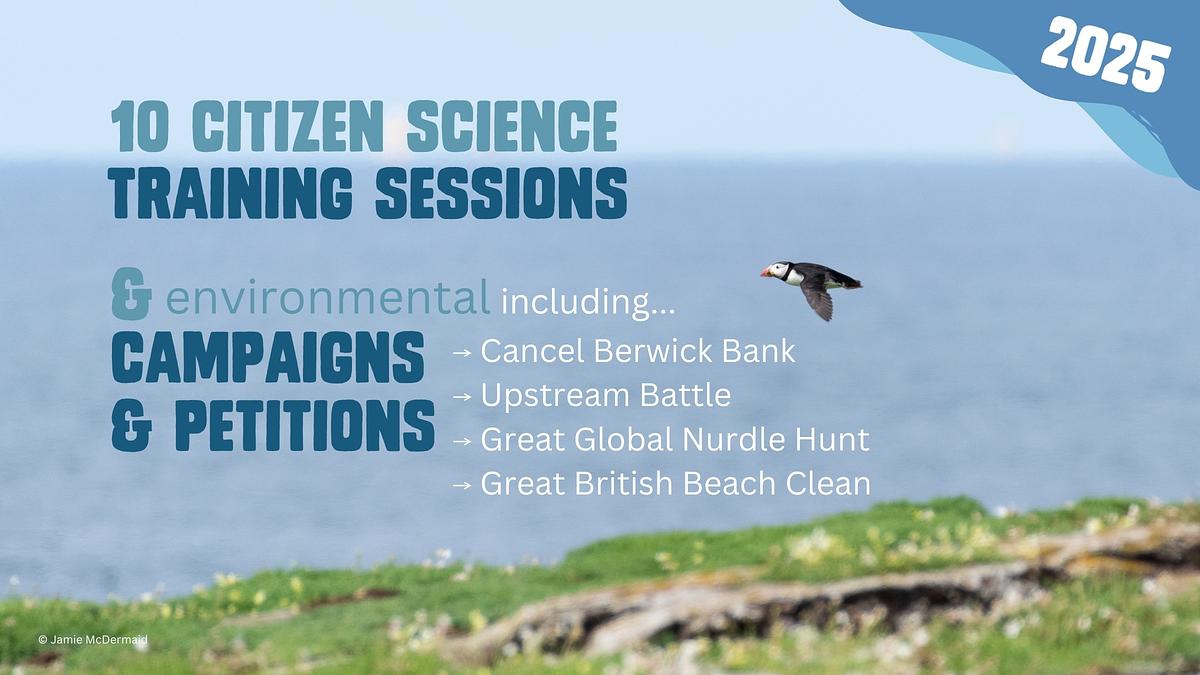
With your involvement, we've also been contributing to national citizen science projects and campaigns around pollution such as the Great British Beach Clean and Upstream Battle. These activities happen every year and are a practical way to gather data to evidence the need for change, so watch out for sessions on our website to get involved!
With new faces joining our team in 2026, we're hoping to do even more in the year ahead.
Marine Mammals
It’s tempting to stay cosy indoors on a cold winter day, but you would be mistaken for assuming that all wildlife does the same! Huge Humpback whales can be seen foraging in and around the Firth of Forth as they head for the nutrient-rich waters of the far north, and Grey seals haul themselves onto the shore to give birth to fluffy white pups.
Craigleith island, a kilometre off North Berwick, nurtures a small breeding population of Grey seals from October to December. The Conservation Team visit the island each year to count the pups, but we must be very careful not to disturb them or their mothers. Using binoculars, 2 or 3 of us watch quietly from afar. We also use the live webcams (which you can view online or in our Discovery Experience) to estimate the total number of pups born. This information is passed over to the Fife Seal Group, who study seal populations in the Forth and Tay estuaries.
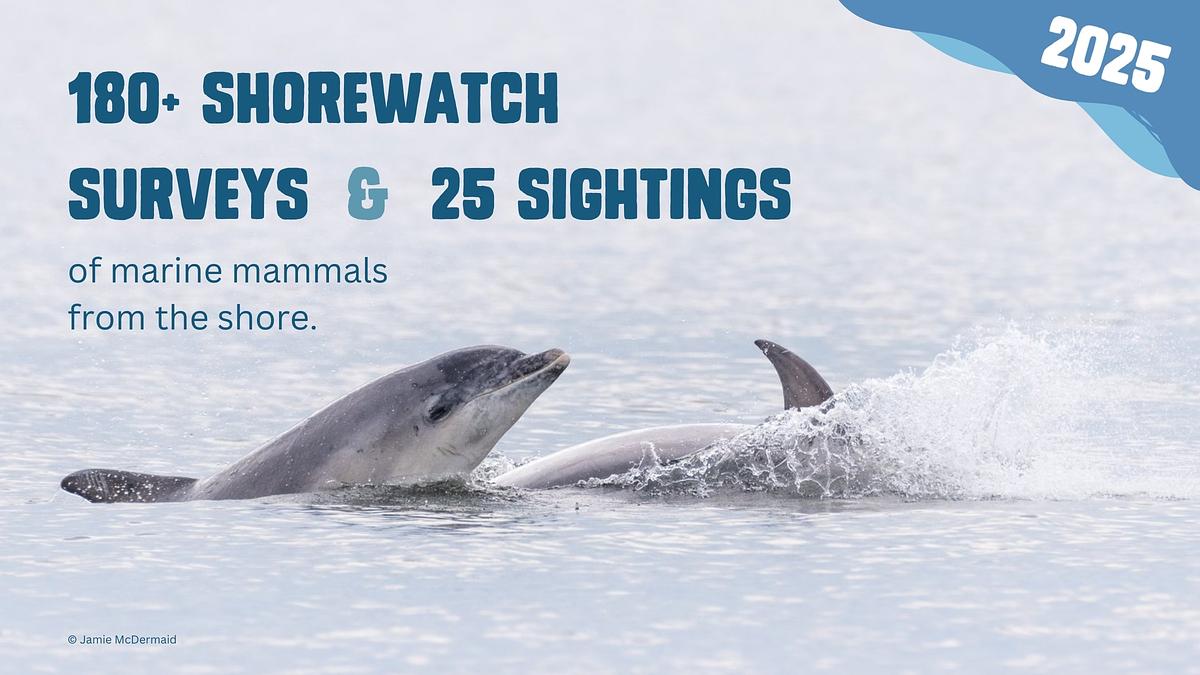
As for whales and dolphins, we’ve had another good year. Dolphins were spotted regularly by visitors on our boat trips and by Shorewatch volunteers. Shorewatch is project run by Whale and Dolphin Conservation and involves volunteers taking part in land-based cetacean surveys. In 2025, volunteers in North Berwick carried out 170+ surveys, during which they spotted dolphins, porpoises, seals... and, incredibly, orca! Why not help us with our search in 2026 and sign up for training?
Tackling Pollution
Scotland's islands and coastlines wouldn’t be as safe or appealing for wildlife if we didn’t keep them clean.
At first glance, picking up litter might not be everyone’s idea of fun, but getting outdoors and being by the sea is a great way to boost your physical and mental health, especially when you get to do it as part of a team. We love it so much, in fact, that our Conservation Team joined Kerrie Flockhart from the Scottish Coastal Cleanup to raise awareness of marine pollution by walking and beach cleaning a whopping 16 ½ hours and 28 miles from the Scottish Seabird Centre in North Berwick to Portobello beach in Edinburgh on the Summer Solstice. We collected 56kgs of litter along the way, including 201 recyclable bottles, and over 70 of you took to the coast to clean your local patch over the weekend.
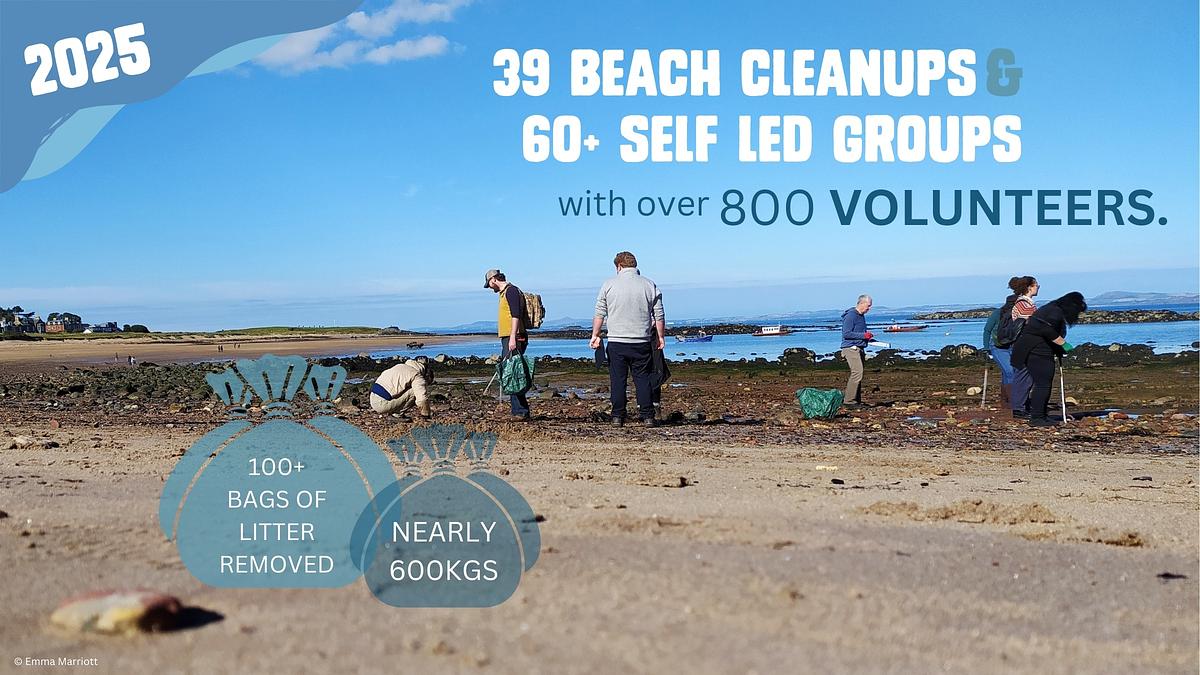
Doing beach cleans makes a genuine difference. Many animals are killed or injured when they swallow or become entangled in litter. Removing even one piece could mean the difference between life and death, so no action is too little or insignificant!
THANK YOU!
We couldn’t do any of this without the support of our members, volunteers, partners, and the simple donations made to help keep our conservation activities running. Thank you all! We’re excited to work alongside you again in 2026.
Header (c) Jamie McDermaid
Thumbnail (c) Emily Burton